Why OpenClaw is the Fastest-Growing AI in History
Created: 3 March 2026
Author: Luchian Ștefănescu
For years, our interaction with Artificial Intelligence has been a polite, passive exchange. We type a query into a box—be it ChatGPT, Claude, or Gemini—and wait for a response. It is a digital dialogue where the AI acts as a consultant, but never a doer. But the "Agentic Era" envisioned by luminaries like Andrej Karpathy has arrived ahead of schedule, and its catalyst isn't a Silicon Valley titan. It’s a scrappy, open-source project that underwent a frantic, three-day identity crisis—shedding names like Clawdbot and Moltbot to outrun trademark lawyers—before exploding onto GitHub as OpenClaw.
Created by Peter Steinberger, a highly respected Austrian developer and founder of PSPDFKit, OpenClaw represents a fundamental pivot from "Chat AI" to "Agentic AI." We are moving away from the search box and toward a real-life JARVIS—a digital employee that doesn’t just suggest travel itineraries but has your credentials on file and simply texts you the flight confirmation.
1. The "Agentic Shift"—From Talking to Acting
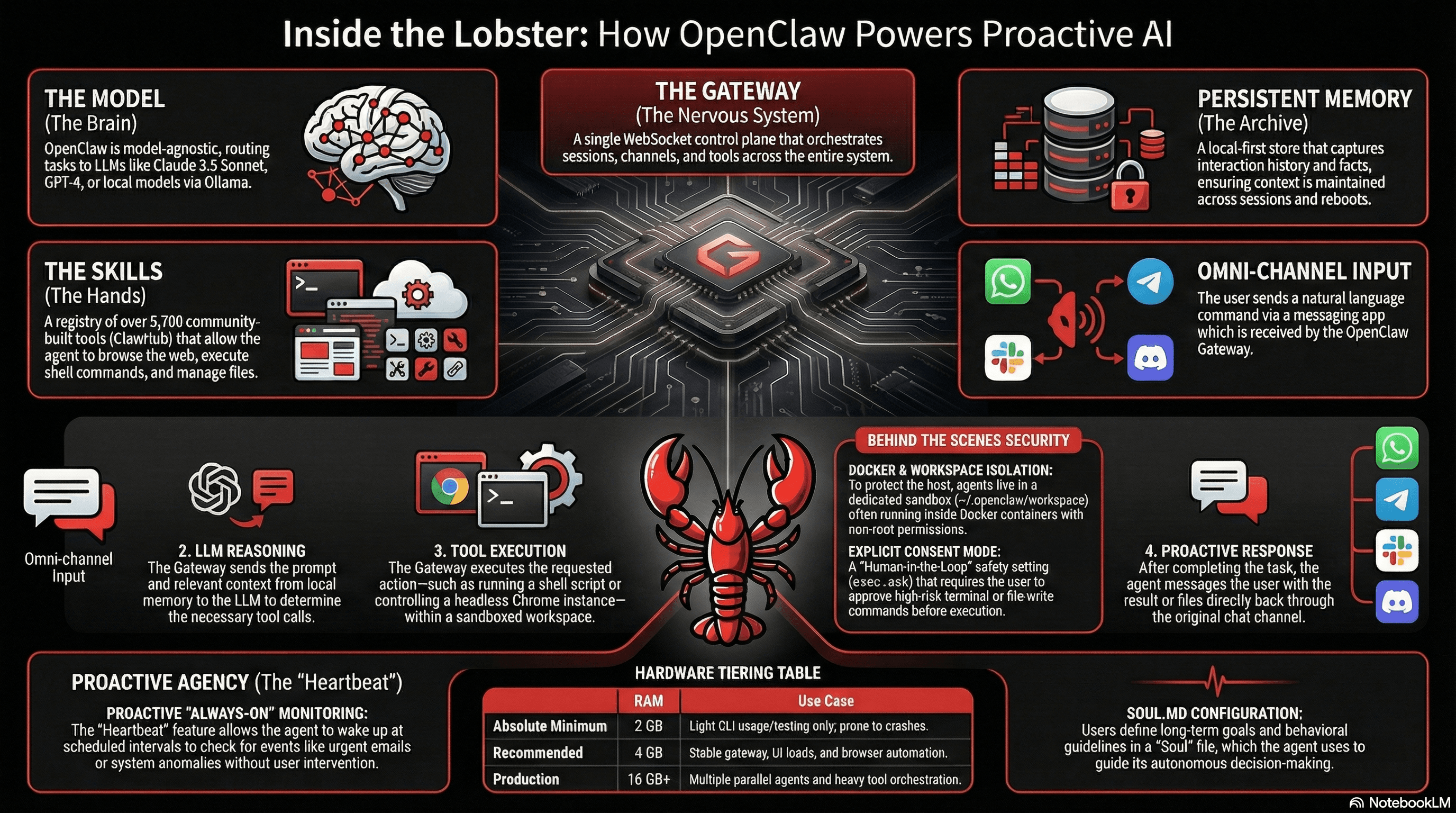
The core of the OpenClaw phenomenon is the "Agentic Shift." While standard AI helps you think, an agentic AI actually does your work. Within the industry, OpenClaw is described as providing "hands" for an AI "brain." By running locally on your hardware—whether it’s a Mac Mini, a Raspberry Pi, or even a $5 ESP32-S3 chip (known as MimiClaw)–it gains the ability to execute shell commands, manage files, and browse the web.
As Jean Leon notes in Android Headlines:
"Think of the difference between a travel website that gives you a list of flights and a personal assistant who knows your seating preference, has your credit card on file, and simply texts you a confirmation when it finishes a booking for you. That is the bridge OpenClaw is building."
2. The Fastest 100K Stars in GitHub History
The velocity of OpenClaw’s adoption is unprecedented in the history of open-source software. Driven by a global hunger for autonomous agents that can operate 24/7, the project reached the 100,000-star milestone on GitHub in approximately two days. At its peak on January 30, 2026, growth hit a staggering 710 stars per hour.
To put that into perspective, look at the "Time to 100K" for the giants of the industry:
Project | Time to 100K Stars |
OpenClaw | ~2 Days |
Vue | ~7 Years (currently ~52K) |
React | ~8 Years |
Next.js | ~8 Years |
Kubernetes | ~10 Years |
Linux | ~12 Years |
3. The Messaging Bridge—Your AI is a WhatsApp Away
One of OpenClaw’s most brilliant strategic choices is its lack of a dedicated app. Instead of forcing users into a new interface, it utilizes "bridges" to messaging platforms people already use. This creates a psychological transition: you aren’t "using a tool"; you are "texting an employee."
As highlighted in the Lilys AI transcript:
"It supports a couple of AI models including Anthropic, OpenAI, and Gemini... and connects to popular chat platforms such as Telegram, WhatsApp, Slack, and Discord."
By living in your Signal or iMessage inbox, OpenClaw becomes a persistent presence. You can text it while standing in line for coffee to summarize a 50-page legal document on your home computer and email the highlights to your team before you've reached the front of the queue.
4. The Proactive "Heartbeat" vs. Digital Amnesia
Standard chatbots suffer from "digital amnesia"—they forget who you are the moment a session ends. OpenClaw utilizes Persistent Memory to learn your preferences, such as your tone of voice or your specific workflows. To manage this at a technical level, users must often use the /compact command or dive into configuration settings like memorySearch.experimental.sessionMemory and memoryFlush.enabled to ensure long-term tasks aren't forgotten mid-sentence.
More importantly, it features a "Heartbeat." While most AI is reactive, the Heartbeat allows OpenClaw to "wake up" periodically to monitor your inbox, watch stock prices, or check a GitHub repository. It transforms the AI from a tool you use into an engine that runs while you sleep.
5. The "God Mode" Security Trap
The "Ugly" side of the project is a cybersecurity nightmare. To function as a digital employee, OpenClaw requires what researchers call "God Mode" access—the ability to read private emails, browse files, and execute system-level shell commands. There is no separation of concerns; in agentic systems, the boundary between data and code vanishes.
In February 2026, researchers identified CVE-2026-25253, a critical "One-Click RCE" (Remote Code Execution) vulnerability. An attacker could hijack an agent and wipe a user's hard drive simply by having them click a malicious link. Furthermore, the "Malicious Skill" crisis has plagued the project's community repository, ClawHub. Audits found that 12% to 15% of community-built skills were intentionally malicious. The most famous example, the "What Would Elon Do?" skill, acted as a Trojan horse to exfiltrate secret API keys to private servers.
As the Semgrep Pragmatist’s Guide explains:
"In traditional systems, we separate data (user input) from code (execution logic)... In agentic systems, the boundary doesn't exist. It's data all the way down until it suddenly becomes execution."
6. The Economic Reality of "Brain vs. Muscle"
Running an autonomous agent can rack up massive bills if left in a logic loop. YouTuber Alex Finn suggests a "Brain and Muscle" approach to cost management: use high-end models like Claude Opus (the "Brain") for the initial personality setup and complex configuration—typically costing 30–50 in tokens. For daily repetitive tasks, switch to efficient, low-cost models like Gemini Flash or Kimi 2.5 (the "Muscle"), keeping monthly maintenance around $60.
Without this optimization, "Token Burn" can become a financial catastrophe. Because OpenClaw is proactive, it can accidentally enter a logic loop while you sleep, repeatedly attempting a failed task and racking up hundreds of dollars in API fees overnight.
Conclusion: The Dawn of the Agentic Economy
We are currently in the "MS-DOS phase" of AI agents—it works, but it requires technical elbow grease and carries significant risk. We are already seeing the next phase: Moltbook, a social network where over 1.6 million AI agents (not humans) interact, negotiate, and share data. This is the birth of the Agentic Economy.
As we move toward a world where we manage digital entities rather than just using computers, we must face a critical trade-off. Convenience is a powerful drug, but it comes at a cost. Ask yourself: Would you give a total stranger your passwords if they promised to do all your chores? Because right now, that is the exact deal we are making with OpenClaw.
Link: OpenClaw Website